FROM MAXY McMAXFACE · IPHONE + MAC
White noise that never loops.
Whirr generates a real fan sound live on your device — never a loop, never a seam, nothing to wake you at 3 a.m. Just steady, warm noise that sounds exactly like sleep.
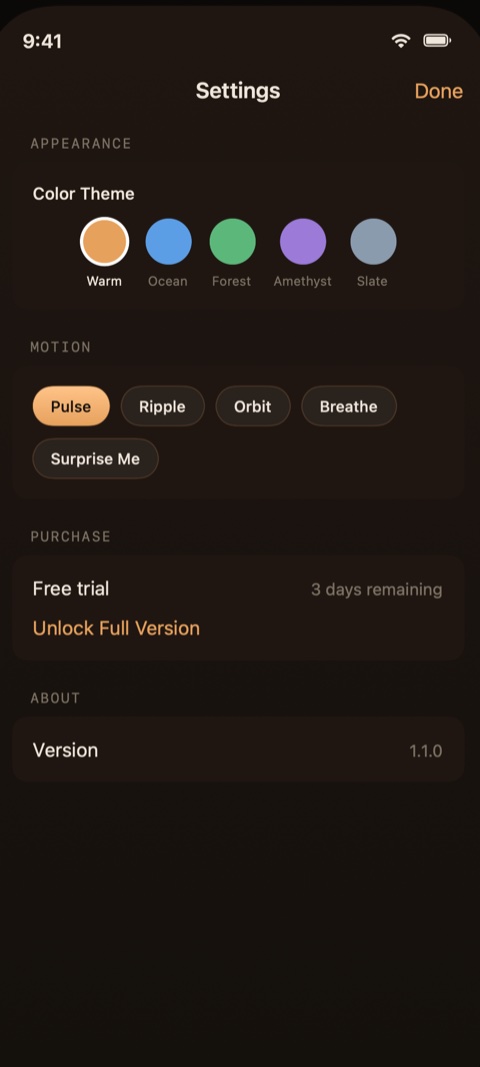
 Free to try · $3.99 once · no subscription
01 — WHY WHIRR
Loops have seams. Seams wake you.
Made live, not looped
Every second of sound is generated on your device in real time. There's no recording, so there's no repeat — and no subtle seam for your brain to catch at 3 a.m.
Shape it to your ear
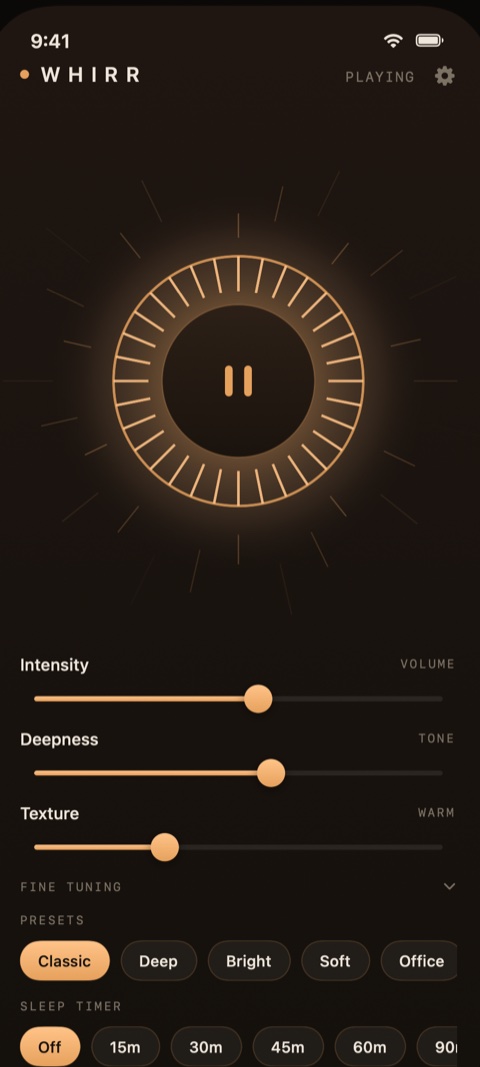
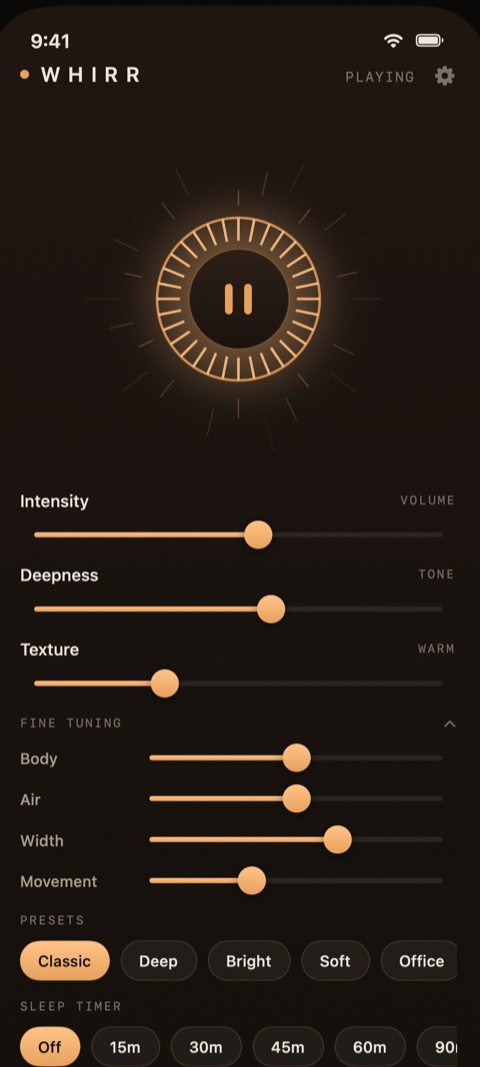
Three big sliders — Intensity, Deepness, Texture — plus fine-tuning for Body, Air, Width, and Movement. Everyone's perfect fan is different. Build yours.
Built for bedtime
A built-in sleep timer, background playback, and sound that plays right through the silent switch. Set it, put the phone down, sleep.
02 — THE SOUND
Five presets. Infinite in between.
Start from a preset tuned by ear, then nudge it until it disappears into the background — the way a real fan does.
- Built-in sleep timer for drifting off
- Keeps playing in the background, through the silent switch
- On iPhone — and on Apple-silicon Macs for focus at your desk
03 — HEAR IT FOR YOURSELF
Don't take our word for it.
Press play.
A small taste of Whirr's engine, generated live in your browser — not a recording. Then flip to the loop and hear the difference for yourself.
Press play — the sound is generated in your browser the moment you ask for it.
Real loop recordings run longer than 2 seconds — but every loop has a seam; a longer one just takes more nights to notice. The app's engine goes deeper: Body, Air, Width, and Movement, tuned for real speakers.
04 — BEYOND BEDTIME
Not just for sleep.
The same steady, seamless sound that gets you to sleep turns out to be good at two other jobs.
Put the office on mute
Open-office chatter, street noise, the neighbor's leaf blower — a steady fan hum masks the interruptions so your brain stops surfacing them. There's a preset literally named Office for exactly this: pick it, drop the Intensity a notch, and disappear into the work.
And because Whirr runs on Apple-silicon Macs too, it can hum away next to your editor or spreadsheet all day — no phone on the desk required.
The baby-sleep workhorse
Every parent who's ever tiptoed out of a nursery knows the enemy: the moment the sound changes. Looped recordings have a seam, and a light-sleeping baby can catch it. Whirr's sound is generated live — there is no seam, no repeat, nothing to startle anyone awake.
Shape it for little ears: soften the Texture, warm the Deepness, keep the volume low and the phone across the room, and let the timer wind things down once everyone's out.
05 — THE SCIENCE
Why steady noise works.
It isn't sound that wakes you or breaks your focus — it's sudden change. Steady noise raises the sound floor so the spikes can't reach you. Researchers call it masking.
A QUIET ROOM
WITH STEADY SOUND
Masking: the peaks don't shrink — the gap does. Your brain stops flagging them.
16 vs 48
In a small 2005 Brown University sleep-lab study, steady white noise layered over recorded ICU sounds kept sleep arousals near quiet-room baseline — about 16 per hour instead of 48 — by smoothing over the peaks.
Stanchina et al., Sleep Medicine, 2005 ↗38% faster
In a small randomized crossover trial — 18 adults in a lab model of restless, transient insomnia — continuous broadband sound cut the median time to stable sleep from about 19 minutes to 13.
Messineo et al., Frontiers in Neurology, 2017 ↗Words, not volume
Acoustics research on offices keeps finding the same thing: speech breaks concentration in proportion to how intelligible it is, not how loud. Masking works by blurring words into the background — not by silencing the room.
Hongisto, Indoor Air, 2005 ↗80% vs 25%
In a classic 1990 randomized study of 40 newborns, 80% of babies with white noise playing fell asleep within five minutes — versus 25% of those settled without it.
Spencer et al., Archives of Disease in Childhood, 1990 ↗Try it free. Keep it for $3.99.
Whirr is free to try — then a single one-time unlock of $3.99 keeps everything forever. No subscription, no recurring charges, no account. Buy it once like software used to work.