
FROM MAXY McMAXFACE · IPHONE + IPAD
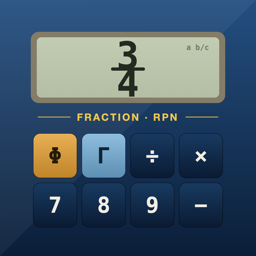
An RPN calculator that thinks in exact fractions.
1/3 + 1/6 is exactly 1/2 — never 0.4999. Whether you're cutting a board, scaling a recipe, piecing a quilt, or checking fraction homework, the answer stays exact.
 Free 2-day trial · $3.99 once · no subscription
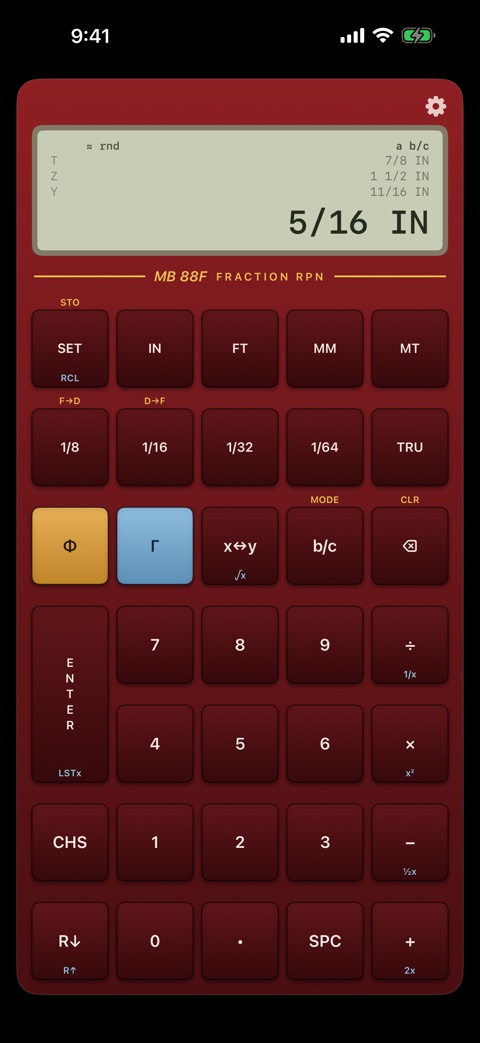
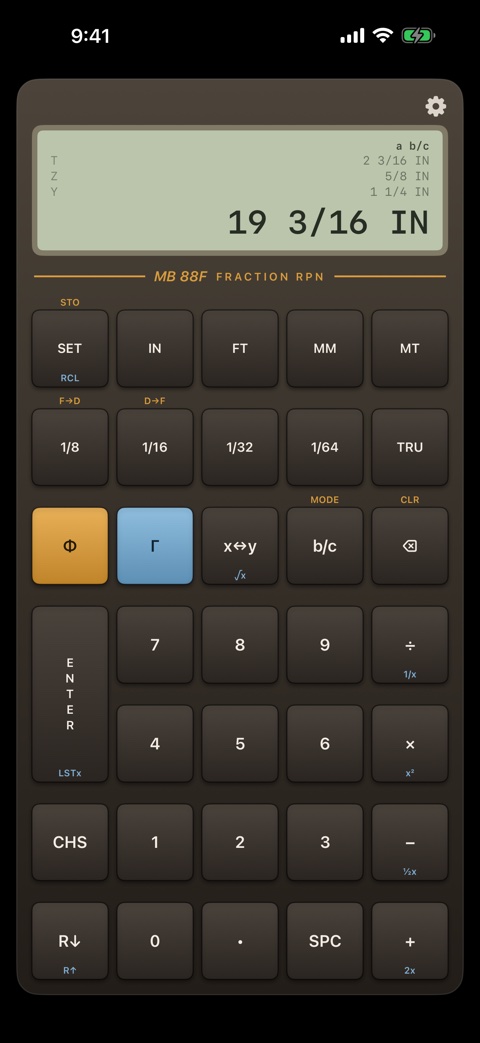
01 — RPN, EXPLAINED
Numbers first. Then the operation.
RPN stands for Reverse Polish Notation — “reverse” because you enter the numbers before the operation, the way you'd say it out loud: “3 and 4… add them.”
There's no equals key and no parentheses to juggle. Numbers go onto a stack; the arithmetic keys combine the top two. Engineers and HP-calculator fans have sworn by it for decades — and it clicks in about a minute. Watch →
(And if it ever doesn't click, the app ships with a built-in manual, key index, and cheat sheet.)
Prefer a standard calculator? MB-88F has a sibling — MB-89F — with the same exact-fraction engine and a normal equals key. Meet MB-89F →
3 ENTER 4 + → 7. That's the whole trick.
Numbers go on a stack
Type a number, press ENTER — it's pushed up onto the stack, ready to be used. Like setting boards on a workbench.
Operations grab the top two
Press + − × ÷ and it combines the two most recent numbers, leaving the answer on the stack for whatever comes next.
That's the whole trick
No equals. No parentheses. Long calculations flow one step at a time, and every in-between result stays visible.
3 ENTER 4 + → 7
# mixed numbers? key 2 1/2 as:
2 SPC 1 b/c 2 → 2 1/2
# and it stays exact:
1b/c3 ENTER 1b/c6 + → 1/2 (never 0.4999)
A LITTLE HISTORY
Born in logic. Raised by engineers.
The idea comes from Polish logician Jan Łukasiewicz, who showed in the 1920s that if you reposition the operators, you can write any expression with no parentheses at all. Put the operators after the numbers and you get the “reverse” flavor — Reverse Polish Notation.
Hewlett-Packard made it famous: starting with the first scientific pocket calculator in 1972, generations of HP machines spoke RPN — and engineers, surveyors, and machinists swore by them for decades. MB-88F carries that lineage on, with fractions.
Why it wins on real jobs fewer keys, fewer errors
- Fewer keystrokes for chained math — no equals between steps
- No parentheses to balance (or lose track of)
- Every in-between result sits on the stack, visible and reusable
- Mistakes surface mid-calculation — not after the final equals
For multi-step shop math — “half this, subtract a kerf, double that” — it's simply less to hold in your head.
02 — BUILT FOR REAL WORK
From the tape measure to the saw.
Tape-measure rounding 1/8 · 1/16 · 1/32 · 1/64
Round any result to the fraction your tape actually shows — then hit TRU to restore the exact value underneath. The math never drifts; only the display does.
Exact units 1 in = 25.4 mm
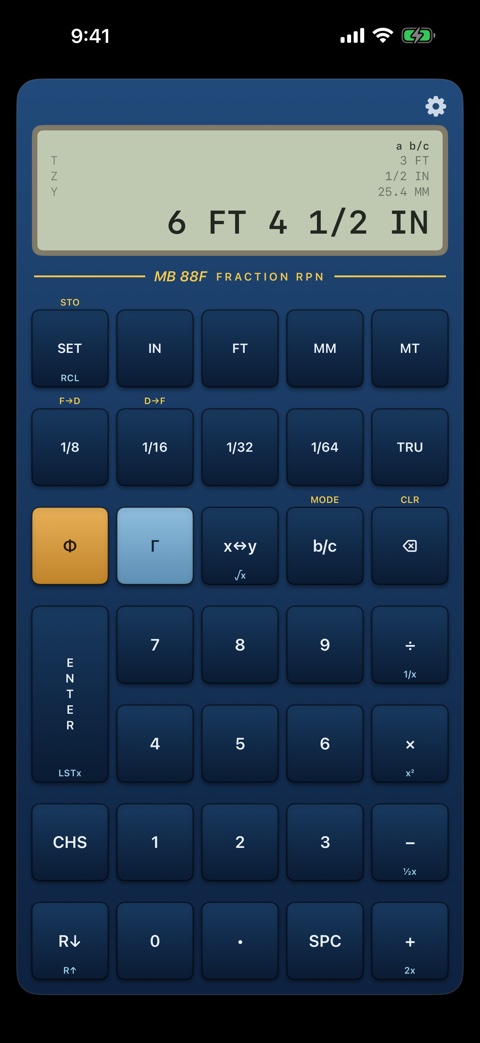
Tag values as inches, feet, millimeters, or meters and convert without losing a thousandth. Feet read the way you say them: 22.5 ft → 22 ft 6 in.
Power keys 1/x · x² · √x · ½x · 2x
Diagonals and right-triangle math, instant centerlines, store/recall memory, Last-X, stack roll — and a history tape holding your last 100 results, each one recallable.
Made to live where you work 100% offline
No account, no ads, no tracking — ever. Your stack, memory, and history survive between sessions. 11 color themes. One app, built for both iPhone and iPad.
03 — WHO IT'S FOR
If you think in fractions, this is your calculator.
- Woodworkers, machinists, carpenters, and framers
- Quilters, sewists, and cooks scaling recipes
- Students working through fraction homework
- Anyone who'd simply rather see 3/4 than 0.75
Two days free. Then $3.99, once.
Try everything free for 2 days, then unlock the full app forever with a single one-time purchase. No subscription, no recurring charges — like software used to work.